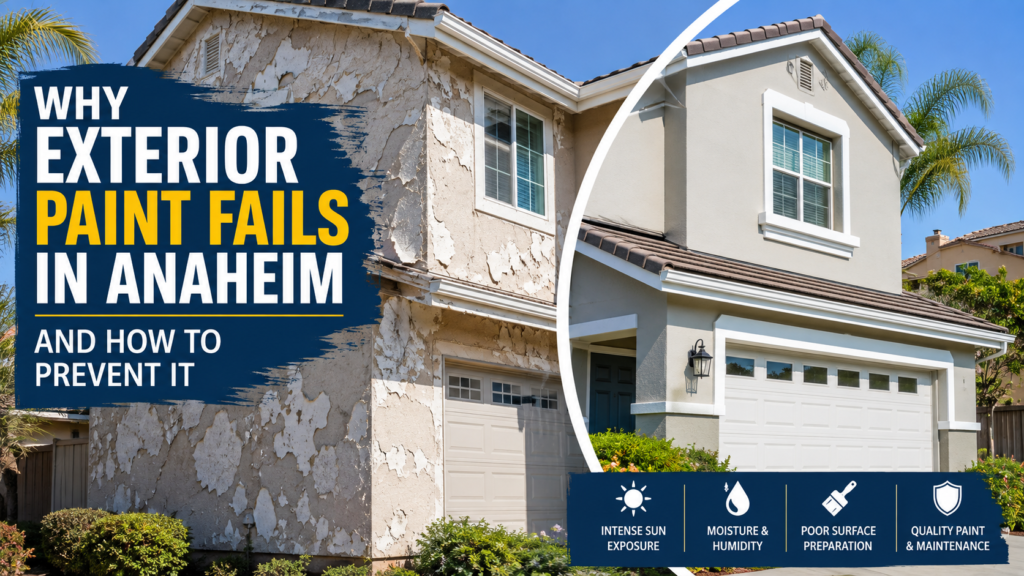
Few things are more frustrating for a homeowner than watching a fresh exterior paint job start to peel, crack, or fade well before it should. Exterior paint Anaheim failure rarely comes down to a single cause. It’s usually the result of a chain of conditions involving the surface being painted, the local climate, moisture, and how carefully the preparation and application steps were handled. Understanding why paint actually fails, rather than simply repainting over the same problem again and again, helps Anaheim homeowners get significantly more life out of their next exterior paint job.
Peeling: The Most Common Complaint
Peeling happens when paint loses its bond to the surface beneath it, usually because moisture has worked its way underneath the paint film. As that trapped moisture pushes outward, it lifts the paint away from the surface, eventually causing it to crack and flake off. Common paths for moisture intrusion include worn or missing caulking around windows, doors, and trim joints, clogged gutters that allow water to back up and seep behind siding, and interior humidity that migrates through walls from bathrooms, kitchens, or laundry rooms with inadequate ventilation. Peeling can also occur simply because paint was applied to a surface that was still damp, whether from recent rain, morning dew, or incomplete drying after washing.
Blistering: When Paint Bubbles Up
Blistering, sometimes called bubbling, occurs when paint lifts away from the surface in small, dome-shaped pockets rather than flaking off in flat sheets. This is most often caused by moisture or trapped heat beneath the paint film. Painting a surface that’s still absorbing heat from direct sun exposure is a common culprit, since the trapped air and moisture beneath the paint expand as the surface warms, pushing the still-curing film upward before it has fully bonded. Applying paint too thickly can produce a similar effect, since a heavier coat takes longer to cure evenly and is more prone to trapping air or moisture beneath the surface.
Cracking, Crazing, and Alligatoring
Fine, web-like cracking across a painted surface, sometimes referred to as crazing or alligatoring depending on the pattern, is typically a sign that the paint film has lost its flexibility and become brittle. Paint naturally hardens over time as its binder continues reacting with oxygen in the air, a slow chemical process that gradually reduces the coating’s ability to flex with the surface beneath it. Sun exposure accelerates this process considerably, since UV radiation breaks down the paint’s polymer structure faster than time and oxidation alone. This is one of the reasons Anaheim’s sun-intensive climate places extra stress on exterior paint compared to a milder, cloudier region, and why paints specifically formulated for UV resistance tend to hold up better here over the long run.
Chalking and Fading
Chalking refers to a powdery residue that develops on a painted surface as the paint’s binder breaks down from prolonged UV exposure, leaving behind loose pigment that rubs off easily to the touch. Fading is a related but distinct issue, where the paint’s color gradually loses vibrancy due to the same UV-driven breakdown process. While some degree of chalking and fading is a natural part of any exterior paint’s aging process, excessive or premature chalking often indicates that a lower-quality paint was used or that the paint wasn’t well suited to the level of sun exposure the surface receives.
Why Surface Material Affects Failure Patterns
Different exterior surfaces tend to fail in different ways, which is part of why matching paint chemistry to the specific surface material matters so much. Wood siding is more prone to peeling and cracking, largely due to natural expansion and contraction as the wood absorbs and releases moisture with changing humidity. Stucco and masonry surfaces tend to show blistering and staining when moisture becomes trapped within the porous material, sometimes appearing as a white, powdery deposit called efflorescence, which signals that water is migrating through the wall and carrying mineral salts to the surface. Metal surfaces, including trim, railings, and some siding types, tend to fade more quickly and can blister under heat exposure if an appropriate primer wasn’t used to create a stable bonding layer.
How Anaheim’s Climate Factors Into Paint Performance
Southern California’s climate, and Anaheim’s in particular, presents a distinct combination of stressors for exterior paint compared to other parts of the country. Consistent, intense sun exposure throughout much of the year accelerates the oxidation process that leads to cracking, fading, and chalking. While the region doesn’t experience the freeze-thaw cycling that stresses paint in colder climates, the sheer amount of annual UV exposure means that paint quality and application technique matter just as much here, if not more, for achieving a long-lasting finish. Homes in shaded areas of a property, by contrast, sometimes face a different challenge: increased susceptibility to mildew growth, since shaded surfaces retain moisture longer than those exposed to direct, drying sunlight.
The Preparation Steps That Actually Prevent Failure
Prevention starts well before the first coat of paint goes on. A thorough preparation process typically includes:
- Washing the surface to remove dirt, dust, chalking residue, and any mildew growth that would otherwise interfere with paint adhesion
- Scraping and sanding any areas of existing peeling or flaking paint down to a stable surface
- Repairing cracks, gaps, and damaged trim, along with recaulking joints and seams where moisture commonly enters
- Allowing surfaces to fully dry before painting begins, since trapped moisture beneath a fresh coat is one of the most common causes of early failure
- Applying an appropriate primer, particularly on bare wood, repaired areas, or surfaces transitioning between different paint types
Skipping or rushing through any of these steps is one of the most common reasons a paint job fails within a year or two rather than lasting the better part of a decade.
Common Questions About Exterior Paint Failure
Why does paint sometimes fail even when it looks like it was applied correctly?
Many causes of paint failure, particularly moisture intrusion from behind a wall, aren’t visible during the painting process itself. A paint job can be applied flawlessly on the surface while an underlying moisture source, like a small roof leak or poor bathroom ventilation, continues to undermine the paint’s adhesion from behind. This is why addressing the underlying cause, not just repainting over the visible symptom, is essential for a lasting fix.
How can homeowners tell the difference between normal aging and premature failure?
Some fading and minor chalking over many years is a normal part of paint’s lifecycle. Premature failure, by contrast, tends to show up as significant peeling, blistering, or cracking within just a year or two of a paint job, often concentrated in specific areas rather than spread evenly across a surface, which usually points to a localized moisture issue or a preparation step that was skipped.
Does the quality of paint really make that much of a difference?
Yes. Higher-quality exterior paints generally contain a greater concentration of resin and pigment solids, which translates into better flexibility, stronger UV resistance, and more durable adhesion over time. In a sun-intensive climate like Anaheim’s, this difference tends to become more apparent over the years as lower-quality paint chalks and fades noticeably faster.
Why does paint sometimes fail in the exact same spot after repainting?
When the same defect reappears in the same location after a fresh coat, it’s almost always a sign that the underlying cause, whether that’s ongoing moisture intrusion, an unresolved ventilation issue, or unstable substrate material, was never actually addressed. Repainting without correcting that root cause typically results in the same failure pattern repeating on a similar timeline.
Maintenance Habits That Extend Paint Life
Beyond the initial application, a few ongoing maintenance habits help exterior paint perform closer to its full potential lifespan. Periodically washing exterior surfaces removes dirt and chalking residue before it accumulates significantly. Keeping gutters and downspouts clear and properly directing water away from the foundation prevents one of the most common sources of moisture-related paint failure. Promptly addressing any small cracks, gaps, or damaged caulking, rather than waiting for a full repaint cycle, helps prevent minor issues from developing into more significant moisture intrusion problems.
Choosing Paint Products Suited to Southern California Sun
Not every exterior paint is formulated the same way, and product selection plays a meaningful role in how well a finish holds up under sustained UV exposure. Paints with higher-quality acrylic resins generally offer better flexibility and resistance to the oxidative breakdown that leads to cracking and chalking. Some product lines are specifically marketed with enhanced UV protection, often through additives designed to slow the degradation of the paint’s binder under prolonged sun exposure. For homes with south- or west-facing walls that receive the most direct sun throughout the day, choosing one of these more UV-resistant formulations can noticeably extend the time before fading and chalking become visible.
Getting the Most Out of an Exterior Paint Job
Exterior paint failure is rarely a mystery once the underlying cause is identified, whether that’s trapped moisture, UV degradation, incompatible paint chemistry, or simply skipped preparation steps. Understanding how these factors interact, and how Anaheim’s specific climate conditions influence which failure modes are most common locally, gives homeowners a clearer picture of what actually goes into a paint job built to last. Anyone researching exterior paint Anaheim homeowners can rely on for long-term performance benefits from asking specifically about surface preparation, moisture assessment, and product selection, since these details typically make the biggest difference in how long a finished paint job actually holds up.